
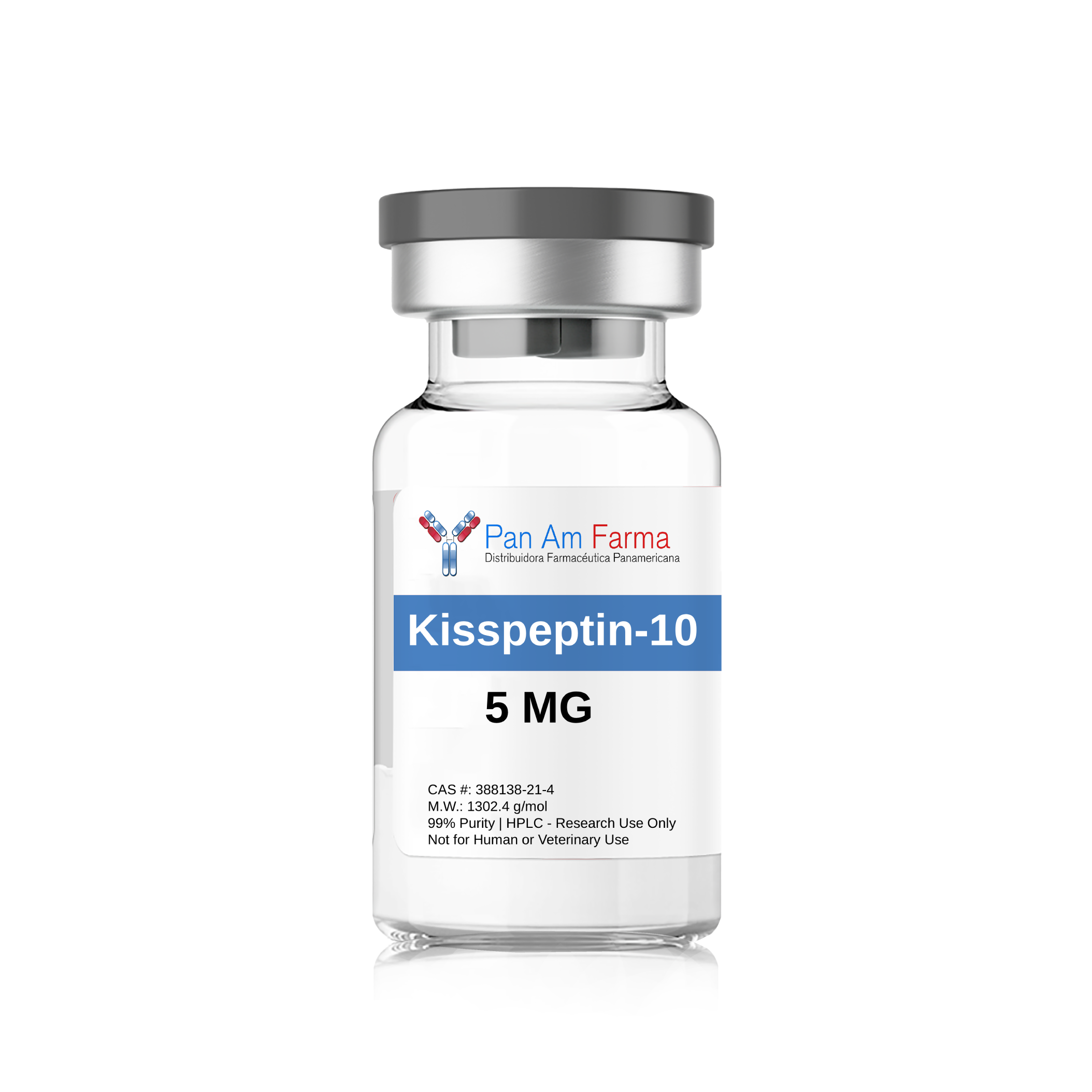
Kisspeptin-10
| Product Overview | |
| Generic Name | Kisspeptin-10 |
| Brand Name(s) | Kisspeptin-10 / Metastin (45-54) |
| Form | Lyophilized powder/injection (IV or SC). |
| Strength | 5 mg |
| Therapeutic Class | A KISS1R (GPR54) agonist / neuroendocrine regulator (GnRH axis activator) |
| ATC Code | not listed |
| Manufacturing & Regulatory | |
| Manufacturer | multiple peptide manufacturers/reagent suppliers |
| Country | India/China/USA |
| GMP Compliance | Not “pharmaceutical GMP finished dosage form |
| DMF/CEP | No public DMF number identified |
| COFEPRIS | No COFEPRIS tender “Clave” identified |
| Free Sale Certificate | Available per batch upon request |
| Logistics & Export | |
| MOQ | 100 units |
| Shelf Life | 6 - 12 Months |
| Storage | store lyophilized at −20 °C |
| Incoterms | EXW/FOB/CIF negotiable |
| Lead Time | 7 - 10 Business Days |
| Documentation | |
| Certificate of Analysis (COA) | Supplied per batch upon request |
| SDS | Upon Request, not publicly posted |
| CTD Summary | No CTD available for approved finished medicine |
Description
Kisspeptin-10 is a potent endogenous ligand/agonist of the kisspeptin receptor (KISS1R/GPR54), upstream of the hypothalamic–pituitary–gonadal axis, and is widely used in research and clinical investigations to modulate GnRH signaling and downstream gonadotropin release (LH/FSH). Human clinical research has evaluated kisspeptin administration in sexual desire/arousal contexts. Kisspeptin-10 is a laboratory-synthesized peptide composed of ten amino acids (Tyr-Asn-Trp-Asn-Ser-Phe-Gly-Leu-Arg-Phe-NH₂), representing the biologically active segment derived from the KISS1 gene. It exerts its biological effects through interaction with the KISS1 receptor (also known as GPR54), triggering intracellular Gq-dependent signaling pathways. In preclinical models, this interaction has been shown to influence the regulation of gonadotropin-releasing hormone (GnRH), making Kisspeptin-10 a widely used research agent for studying reproductive physiology and neuroendocrine signaling mechanisms.